Trigonometry Reference
Right Triangles
Right-triangle trigonometry connects an acute angle to fixed side ratios. Label the triangle first, then choose the ratio that uses the sides in the problem.
Solved Examples
Jump directly to a worked example by problem type.
Fact Table
| Situation | Known Sides | Use |
|---|---|---|
| Find a missing side in any right triangle. | Two side lengths. | Pythagorean theorem. |
| Angle with opposite and hypotenuse. | $O$ and $H$ | Sine. |
| Angle with adjacent and hypotenuse. | $A$ and $H$ | Cosine. |
| Angle with opposite and adjacent. | $O$ and $A$ | Tangent. |
| Find an angle from side lengths. | A trig ratio. | Inverse sine, inverse cosine, or inverse tangent. |
| Angles are $30^\circ$, $45^\circ$, or $60^\circ$. | One side in a special triangle. | Special right-triangle patterns. |
Content Formulas
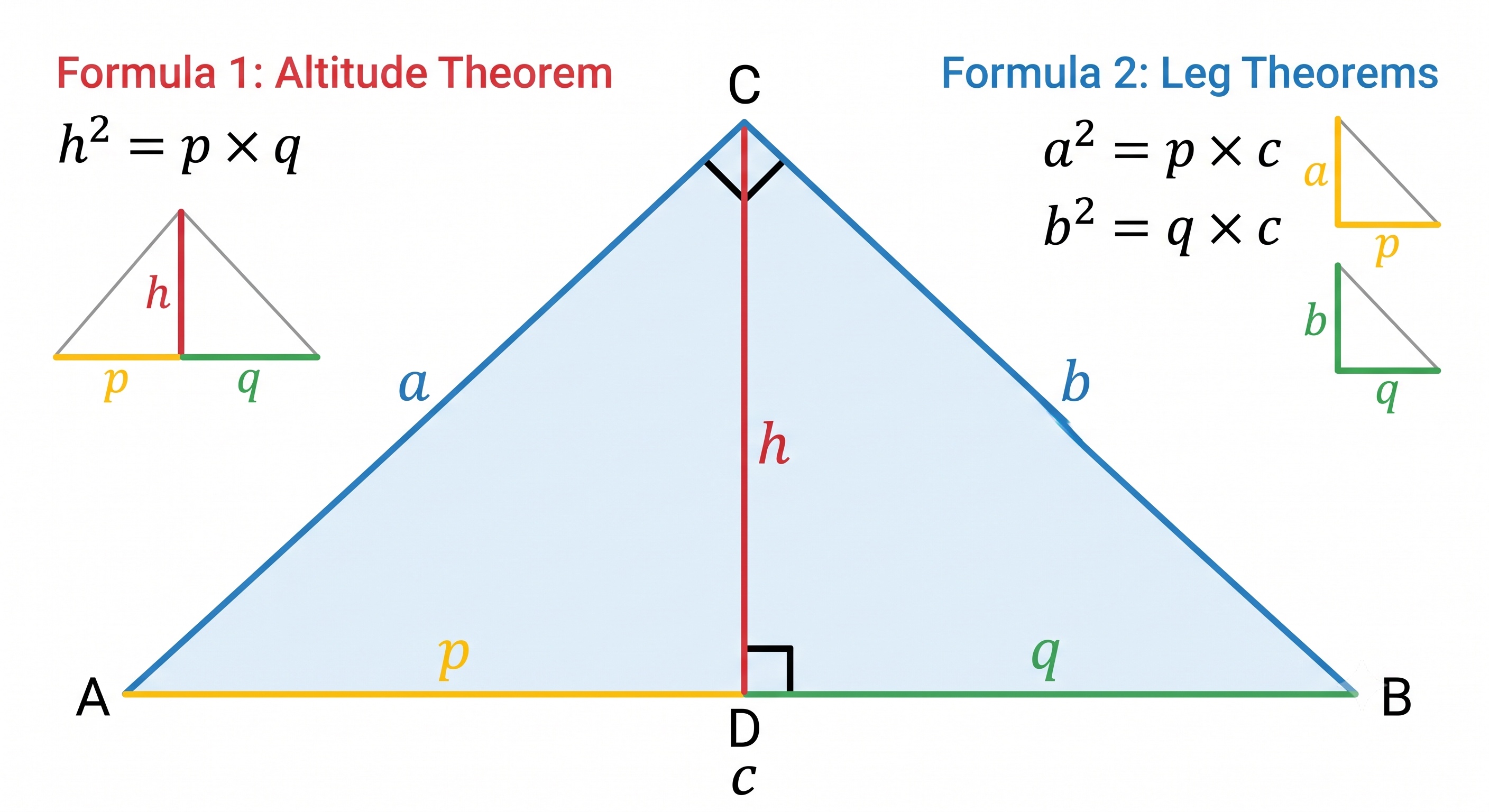
Altitude to the Hypotenuse
Drop an altitude from the right angle to the hypotenuse. It divides the large right triangle into two smaller right triangles, and all three triangles are similar.
| Label | Meaning | Altitude Rule |
|---|---|---|
| $c$ | Hypotenuse | $c=p+q$ |
| $a,b$ | Legs | $a^2=cp$, $b^2=cq$ |
| $h$ | Altitude to the hypotenuse | $h^2=pq$ |
| $p,q$ | Two hypotenuse segments | $\frac1{h^2}=\frac1{a^2}+\frac1{b^2}$ |
Classic Examples
Altitude in a 3-4-5 Triangle
A right triangle has legs $a=3$, $b=4$, and hypotenuse $c=5$. Find the altitude to the hypotenuse and the two hypotenuse segments.
- Use the leg rules to find the two hypotenuse segments.
- Use the altitude rule with the two segments.
- Take the positive square root to find the altitude.
- Check that the two segments add to the hypotenuse.
Label the Triangle
For the marked angle $\theta$, identify the opposite side, adjacent side, and hypotenuse.
- Identify the hypotenuse as the side opposite the right angle, then name the other sides relative to $\theta$.
Missing Hypotenuse
A right triangle has legs 9 and 12. Find the hypotenuse.
- Substitute the two known legs into the Pythagorean theorem.
- Combine the squared leg lengths.
- Simplify the square of the hypotenuse.
- Take the positive square root and state $c=15$.
Sine for Height
A ladder is 10 feet long and makes a $30^\circ$ angle with the ground. How high does it reach?
- Use sine because height is opposite and the ladder is the hypotenuse.
- Solve for the height and state $h=5$ feet.
Cosine for Run
A 20-foot ramp makes a $60^\circ$ angle with the ground. Find the horizontal run.
- Use cosine because the run is adjacent and the ramp is the hypotenuse.
- Solve for the run and state $x=10$ feet.
Tangent for Shadow
A flagpole casts a 30-foot shadow when the angle of elevation is $45^\circ$. Find the height.
- Use tangent because height is opposite and the shadow is adjacent.
- Solve for the height and state $h=30$ feet.
Inverse Angle
A right triangle has opposite side 6 and hypotenuse 12 relative to $\theta$. Find $\theta$.
- Use sine because the opposite side and hypotenuse are known.
- Apply inverse sine and state $\theta=30^\circ$.
45-45-90 Diagonal
A square has side length 9. Find the diagonal.
- Use the 45-45-90 pattern to state the diagonal: $d=9\sqrt2$.
30-60-90 Triangle
A 30-60-90 triangle has hypotenuse 16. Find the short leg and long leg.
- Set twice the short leg equal to the hypotenuse.
- Solve for the short leg.
- Multiply the short leg by $\sqrt3$ to find the long leg.